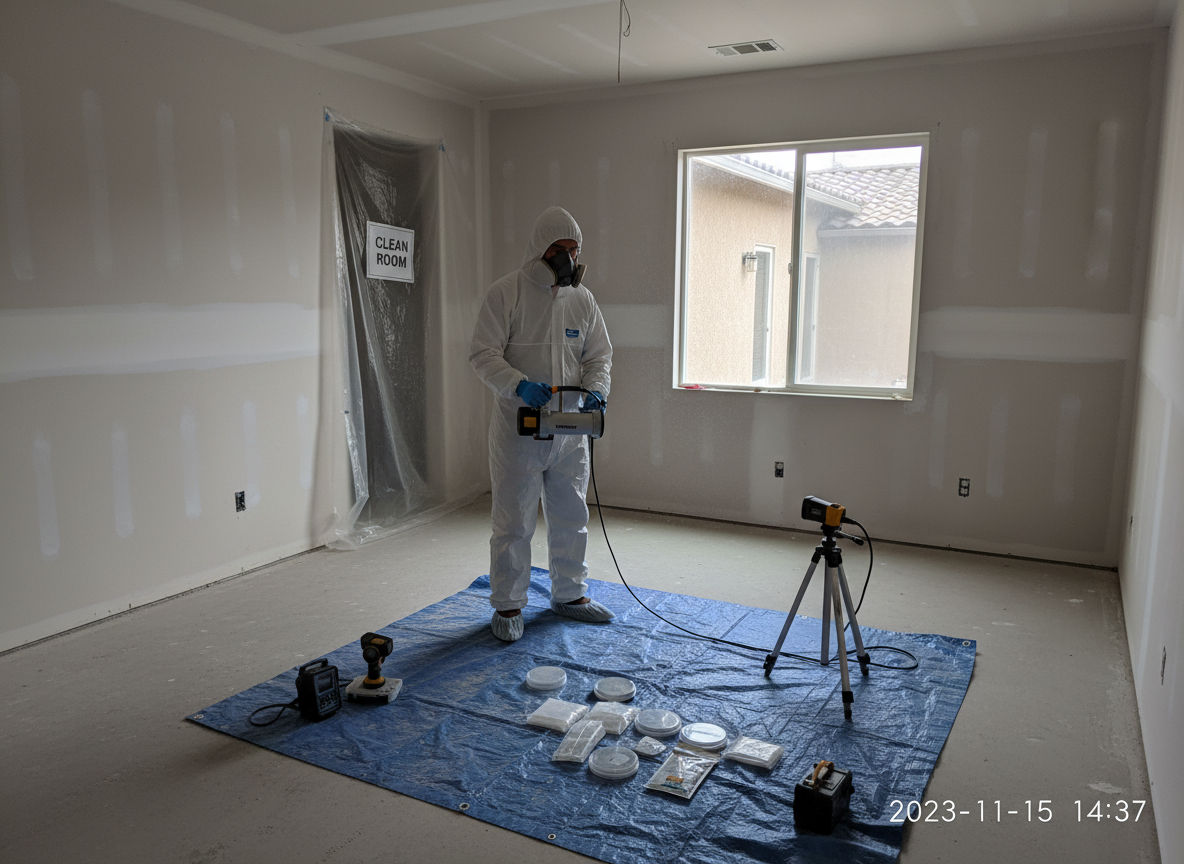
Post remediation mold testing in North Hills requires air and surface sampling after visible mold and affected materials have been removed. Homes built in the 1950s through 1970s in North Hills East and North Hills West often contain older drywall, plaster, and HVAC systems that trap residual spores even after remediation. Technicians collect samples from multiple rooms, including behind baseboards and inside ductwork, because the hot-summer Mediterranean climate with dry summers can mask ongoing moisture issues until the first winter rains arrive. Results are compared against outdoor control samples taken near North Hills Park to determine whether indoor spore counts meet clearance criteria.
Los Angeles County does not mandate specific post-remediation testing protocols, yet many insurance carriers and real-estate transactions in Panorama City and Granada Hills require documented clearance. Edge cases arise when remediation stops at visible growth but leaves hidden colonies in crawl spaces or behind stucco that faces the Sepulveda Basin floodplain. Technicians use both spore-trap cassettes and tape-lift samples, then send them to an accredited laboratory for genus-level identification. Homeowners receive a written report that states whether the property meets industry-accepted post-remediation criteria or needs additional containment and removal.
Testing must occur after the remediation crew has finished cleaning and before any new construction or furnishings are introduced. In North Hills, summer heat can dry surfaces quickly, giving a false sense that moisture has been eliminated when humidity rebounds inside wall cavities. Proper negative-air pressure during sampling prevents cross-contamination from unaffected areas. Reports include chain-of-custody documentation and laboratory data sheets so property owners can show insurers or buyers that the work zone has returned to normal background levels.
Technician insight
In North Hills the thing that catches most people out with post remediation mold testing is older stucco homes in North Hills West that back up to the Sepulveda Basin; even after drywall removal, the concrete slab and weep screed stay damp through the dry summer months and release spores again once fall humidity rises.
Hidden Moisture Behind Slab in North Hills East
A 1962 ranch house showed visible mold in the laundry room after a pipe leak. Remediation removed the drywall and base cabinets, yet post-remediation testing still detected elevated Aspergillus indoors. Additional moisture mapping found trapped water beneath the slab near the foundation that faced the basin. Targeted drying and a second round of removal brought spore counts down to outdoor background levels.
How it works
- 1
Site Walk and Containment Check
Technician inspects all previously affected areas in the North Hills property to confirm physical removal is complete and containment barriers remain intact.
- 2
Sample Collection
Air and surface samples are gathered from multiple locations inside the home and one outdoor control near Sepulveda Basin to establish background levels.
- 3
Laboratory Analysis
Samples are sent to an independent lab for spore count and identification; results typically return within 24 to 48 hours.
- 4
Clearance Report Delivery
Written report states whether the property meets post-remediation criteria and notes any locations requiring further work.
Pricing
Cost depends on square footage tested, number of samples required, and whether the property is a single-family home or multi-unit building in North Hills.