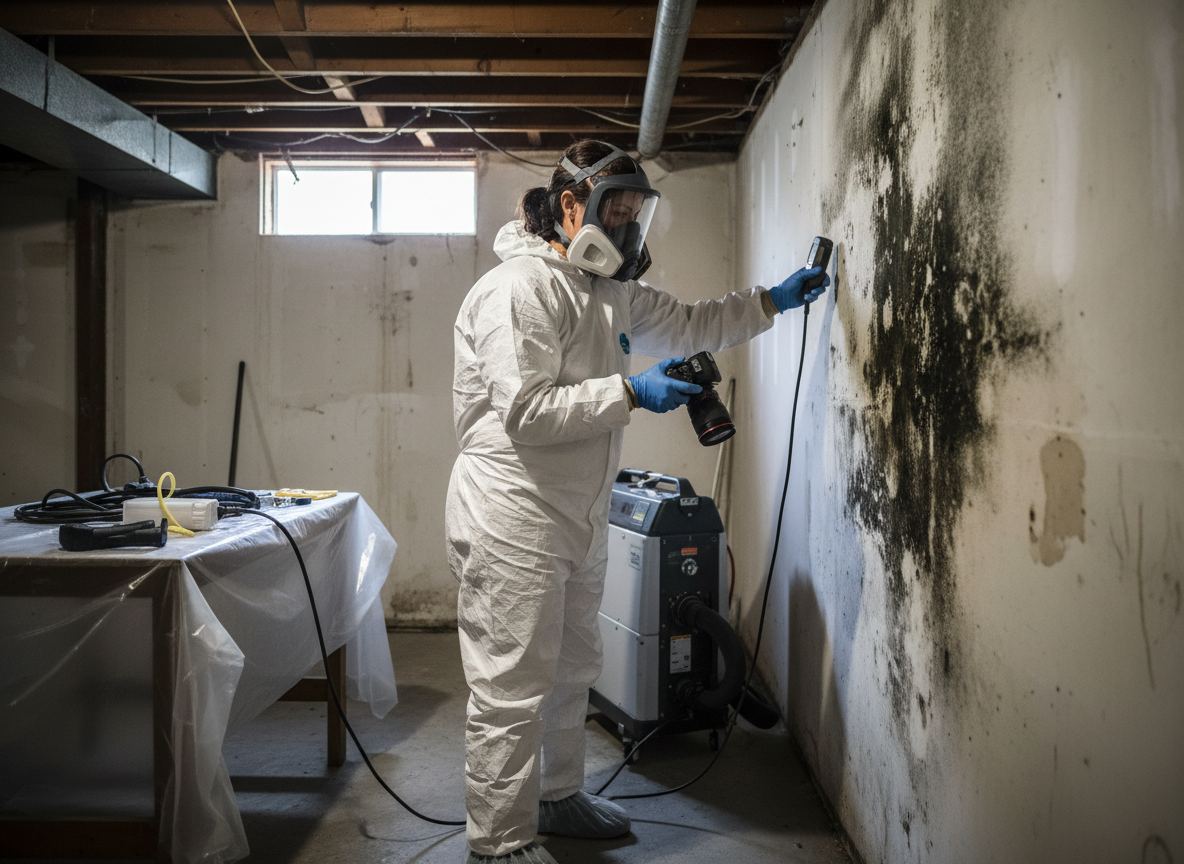
North Hills homes built from the 1950s onward often feature stucco exteriors and slab foundations that trap moisture after rare winter rains. Black mold frequently appears in attics where roof vents allow humid air to mix with insulation, especially in North Hills East near older plumbing lines. Dry summers reduce surface growth but leave hidden colonies active behind walls until air conditioning condensation restarts the cycle.
Properties bordering Sepulveda Basin face additional risk from seasonal groundwater seepage that travels under slabs into North Hills West neighborhoods. Standard visual checks miss these because mold stays dormant until humidity spikes inside. Inspectors must lift carpet edges, probe HVAC registers, and check behind kitchen cabinets where leaks from Panorama City-style tract homes commonly migrate.
Los Angeles building codes require proper ventilation in bathrooms and laundry rooms, yet many Granada Hills-adjacent homes still rely on single-pane windows that create cold spots and condensation. During inspection we map moisture with meters rather than relying on smell alone, since the hot-summer climate dries surfaces quickly and hides active growth until it reaches drywall paper backing.
Technician insight
In North Hills the thing that catches most people out with black mold inspection is how dry summers let moisture sit behind stucco on 1960s homes near North Hills Park until one winter storm pushes it into the insulation and nobody notices until the smell hits the living room.
Crawlspace Growth After Basin Runoff
Problem: Musty odor appeared in a North Hills West home after winter rains. We found: Active black mold on joists from groundwater moving under the slab from Sepulveda Basin drainage. What we did: Full moisture mapping and air sampling throughout the structure. Outcome: Clear report allowed targeted removal without unnecessary wall demolition.
How it works
- 1
Initial Consultation
Review property history and any musty odors or water events reported in North Hills East or West.
- 2
Visual and Moisture Assessment
Inspect attics, crawlspaces, and wall cavities using meters around Sepulveda Basin drainage paths.
- 3
Air and Surface Sampling
Collect samples from HVAC systems and high-risk zones common to 1950s-1970s tract homes.
- 4
Report and Recommendations
Deliver findings with photos and next-step options based on local climate and housing conditions.
Pricing
Inspection cost depends on square footage, number of samples, and access difficulty in older North Hills homes.