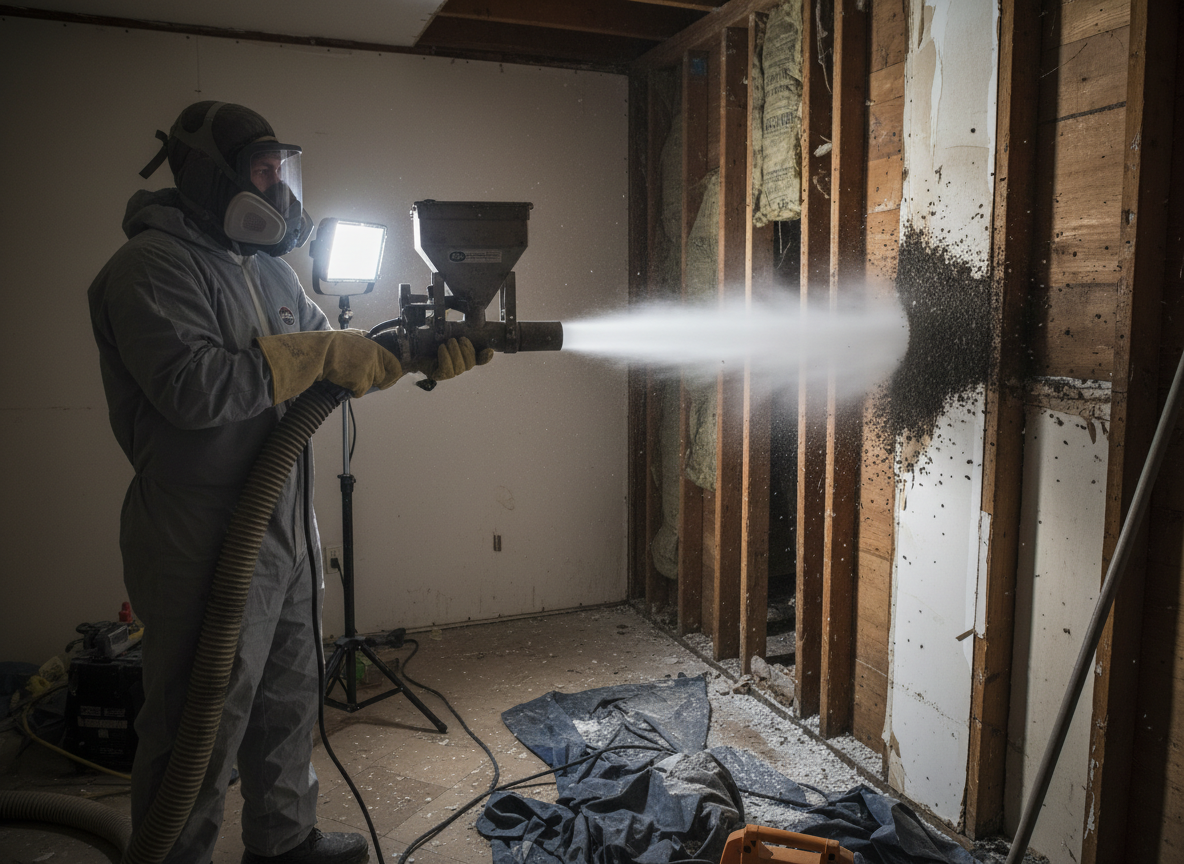
Dry ice blasting uses solid carbon dioxide pellets accelerated at high velocity to dislodge mold colonies from porous and non-porous surfaces without added moisture or chemical residues. In North Hills East and North Hills West, many single-family homes built between the 1950s and 1970s feature stucco over wood lath and enclosed attics that trap spores after occasional winter rains. The hot-summer Mediterranean climate keeps summers arid, but once moisture enters through roof penetrations near Sepulveda Basin, mold spreads quickly inside wall cavities before visible signs appear on drywall.
Technicians contain the work area with plastic sheeting and negative air machines to prevent cross-contamination into living spaces common in the dense layouts of Panorama City and Granada Hills. Pellets sublimate on impact, leaving only the loosened mold for HEPA vacuum removal. This method works well on textured ceilings and around electrical boxes where sandblasting would damage wiring or framing. Los Angeles County building codes require proper disposal of contaminated materials and documentation of moisture source correction before final clearance testing.
Edge cases include crawlspaces under raised foundations where soil moisture from the basin area persists year-round despite surface dryness. Blasting here requires additional dehumidification afterward to drop relative humidity below 50 percent. Homeowners often overlook HVAC ducts that run through unconditioned attics; spores can re-enter living areas if those lines are not addressed during the same visit.
After blasting, crews apply antimicrobial coatings only where code allows and only on non-food-contact surfaces. Final air sampling confirms spore counts match outdoor baselines before containment is removed. This step-by-step verification protects families in North Hills from recurring growth during the next wet season.
Technician insight
In North Hills, the thing that catches most people out with dry ice blasting mold is hidden moisture trapped under 1960s stucco near Sepulveda Basin; the dry summers mask the problem until spores reach the drywall, and blasting alone fails if you skip the dehumidification step afterward.
North Hills West Attic Outbreak
Homeowner noticed musty odor after winter rains. Inspection found mold on rafters in a 1962 home near North Hills Park. Dry ice blasting removed colonies from wood without damaging insulation. Clearance testing passed the next day and the family returned to normal occupancy.
How it works
- 1
Site Assessment
Inspect attics, walls, and crawlspaces in North Hills homes to map moisture sources and mold extent.
- 2
Containment Setup
Seal affected rooms with plastic barriers and run negative air machines to protect adjacent living areas.
- 3
Dry Ice Blasting
Apply CO2 pellets to affected surfaces in North Hills East and West properties, removing colonies without surface damage.
- 4
HEPA Vacuum and Disposal
Collect loosened debris and dispose of waste per Los Angeles County guidelines.
- 5
Clearance Testing
Perform air sampling to verify spore levels return to outdoor baselines before reopening spaces.
Pricing
Cost depends on square footage treated, access difficulty in older North Hills homes, and whether HVAC ducts require separate attention.