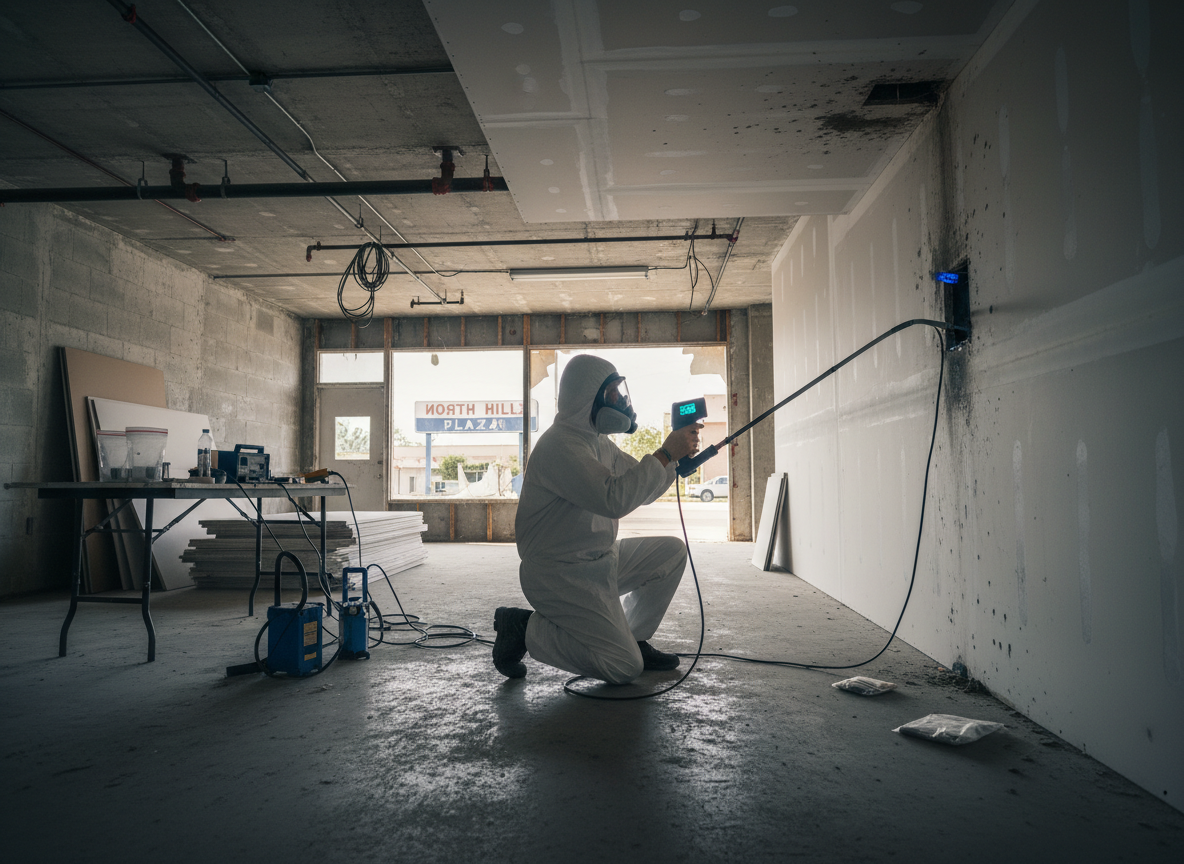
Commercial properties in North Hills East and North Hills West often feature flat-roof warehouses and single-story retail built between the 1960s and 1980s. These structures sit on soil that drains poorly near the Sepulveda Basin, allowing winter rain to pool against foundations even during the dry summers typical of the hot-summer Mediterranean climate. When HVAC units cycle in summer heat, temperature differentials pull moisture into wall cavities and above drop ceilings, creating hidden growth that visual checks miss. Inspectors must use moisture meters on concrete slabs and thermal imaging on metal decking to locate these pockets before they spread into tenant spaces.
Los Angeles County commercial codes require documented moisture source correction before any remediation can begin. In North Hills, this means tracing leaks back to common failure points such as parapet walls around North Hills Park commercial strips or degraded flashing on buildings bordering Van Nuys and Panorama City. Inspectors document air flow patterns through loading docks and exhaust fans that pull basin humidity inward during Santa Ana wind events. Skipping these steps leaves owners exposed to repeated callbacks and potential violations during tenant turnover inspections.
Edge cases appear regularly in Granada Hills border properties where older plumbing runs under slab-on-grade floors. A single pinhole leak can saturate subflooring for months before odors reach occupied areas. Commercial mold inspection here includes core sampling of carpet padding and acoustic tile, plus pressure mapping of return-air plenums that often cross property lines. These details determine whether the job stays contained to one suite or requires coordination across multiple tenants.
Technician insight
In North Hills, the thing that catches most people out with Commercial mold inspection is moisture trapped under older slab-on-grade retail floors near the Sepulveda Basin. Dry summers hide the fact that winter rain still migrates under foundations, and HVAC negative pressure pulls it upward into tenant spaces. Many owners skip slab testing and end up with recurring growth after the first rain.
Warehouse Office Suite Near Nordhoff
Management noticed musty odors in a North Hills West warehouse office after a tenant moved out. Inspection found elevated moisture along the rear slab where the building meets the basin drainage swale. Thermal scans showed damp subflooring under carpet tiles fed by a slow roof drain leak. We documented the source and handed the report to the owner for repair before any remediation began.
How it works
- 1
Initial Site Walk
Technician reviews building plans and interviews property management about past leaks, HVAC changes, and tenant complaints while walking every accessible area including roof, crawl spaces, and mechanical rooms.
- 2
Moisture and Thermal Mapping
Non-invasive meters and infrared cameras scan walls, ceilings, and slabs to identify hidden damp zones without demolition, focusing on transitions where concrete meets wood framing common in North Hills commercial stock.
- 3
Air and Surface Sampling
Spore traps and tape lifts are collected from suspect locations and sent to an independent lab; results guide whether growth is active or settled dust from outside air drawn through Sepulveda Basin vents.
- 4
Source Documentation and Report
Findings are compiled into a written report with photos, moisture readings, and recommended next steps that comply with Los Angeles County requirements for commercial properties.
Pricing
Pricing depends on square footage, number of stories, and access difficulty; contact for an upfront quote based on the specific North Hills property.