North Hills homes, especially those built in the 1950s through 1970s in North Hills East and North Hills West, often feature older roof assemblies with limited ridge venting and kraft-faced insulation that traps condensation when temperatures swing between hot summer days and cooler nights. Attic mold commonly appears along rafters and on the underside of plywood sheathing near plumbing vents or HVAC ducts that leak during the dry season when residents run evaporative coolers. Testing requires air sampling and surface swabs sent to accredited labs rather than visual checks alone because black mold can hide behind blown-in cellulose that was added during later energy upgrades.
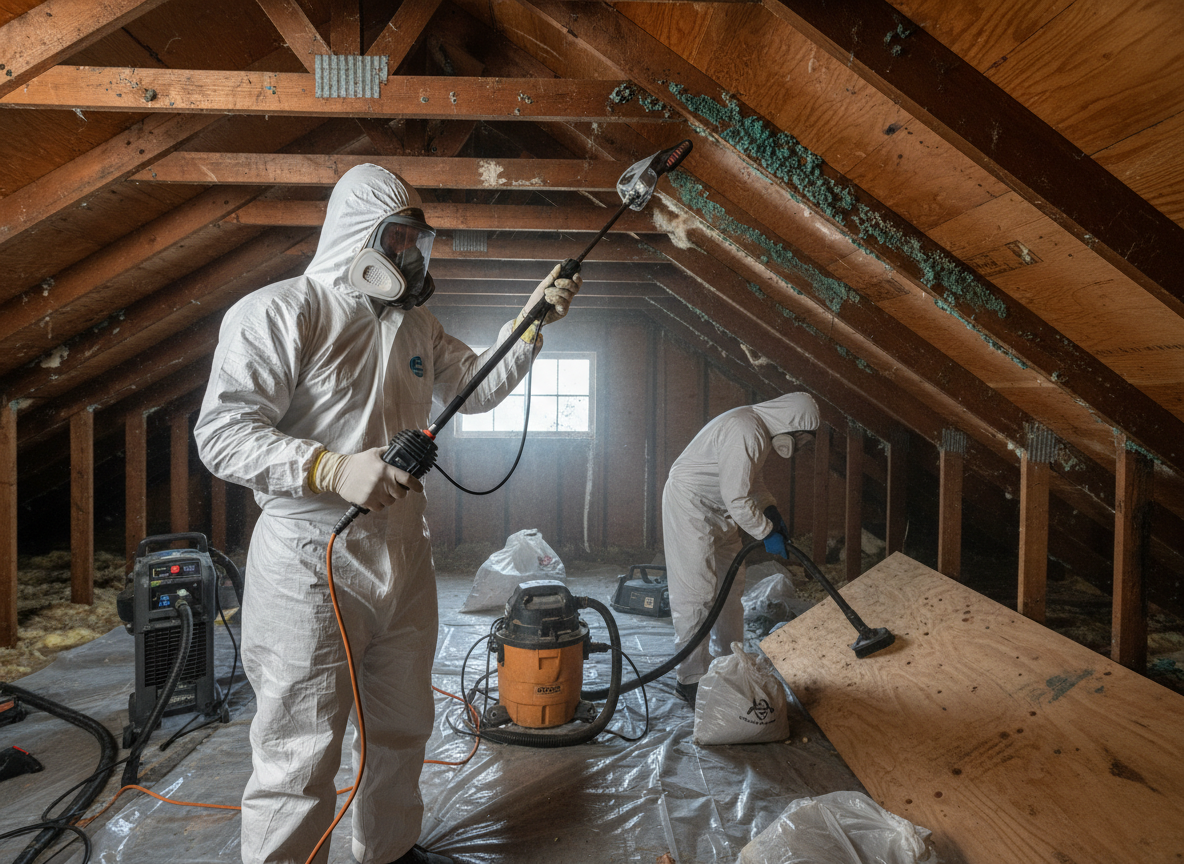
Removal work in these attics demands full containment with negative air machines exhausting through windows facing Sepulveda Basin to avoid cross-contaminating living spaces below. Crews must remove affected insulation in sealed bags, HEPA-vacuum rafters, and apply antimicrobial coatings only after moisture sources are corrected; simply spraying without fixing roof leaks or poor ventilation leads to rapid regrowth during the next winter rain. Los Angeles County building codes require proper disposal documentation for any material exceeding ten square feet, and homeowners near Granada Hills frequently discover that their insurance policies exclude gradual leaks common in the area's stucco and flat-roof additions.
Access challenges arise in single-story ranch homes common around North Hills Park where low-pitch roofs limit crawl space and force technicians to work from exterior scaffolding. Post-remediation clearance testing verifies spore counts have returned to outdoor baselines before new insulation is installed. Residents in Panorama City and Van Nuys report that attic mold often coincides with bathroom exhaust fans venting directly into the attic rather than through the roof, a detail that must be corrected during every job to prevent recurrence in the hot-summer Mediterranean climate.
Technician insight
In North Hills the thing that catches most people out with Attic mold testing and removal is the combination of 1960s-era low-pitch roofs and bathroom fans dumping moist air straight into the attic; once the dry summer heat pulls that moisture up through the insulation it condenses on the cooler north-facing rafters near North Hills Park, and homeowners keep finding the same patch returns every winter because they never reroute the vent.
Hidden Growth Behind Insulation Near Sepulveda Basin
Homeowner in North Hills West noticed musty smell after a roof leak. We found active growth on sheathing hidden behind cellulose insulation added in the 1990s. Containment was set, wet material removed, fans dried the space for three days, and clearance samples passed before new insulation went in.
How it works
- 1
Initial Assessment
Technician arrives within hours, performs moisture mapping and borescope inspection through existing access points to locate hidden growth without disturbing insulation.
- 2
Sampling and Lab Analysis
Air and surface samples collected and sent for same-day results to confirm species and concentration before any containment is built.
- 3
Containment and Removal
Six-mil plastic barriers erected, negative air established, affected insulation and sheathing sections removed in sealed bags for proper disposal.
- 4
Drying and Treatment
Dehumidifiers and air movers run until wood moisture content drops below 12 percent, followed by EPA-registered antimicrobial application on rafters.
- 5
Clearance and Documentation
Independent post-remediation testing confirms levels match outdoor baselines; written report provided for insurance or real-estate needs.
Pricing
Cost depends on attic size, depth of insulation, and whether roof repairs are needed before work begins.